Laser eye surgery today allows us to eliminate all vision defects ( Myopia , Astigmatism , Hyperopia , Presbyopia ). The laser allows you to modify the curvature of the cornea by changing its shape and power. There are two types of laser: the excimer laser and the femtosecond laser . The excimer laser vaporizes the corneal tissue while the femtosecond laser creates cuts that allow the corneal tissue to be removed. The main laser techniques for eliminating glasses and contact lenses are: PRK, LASIK and SMILE. In addition to the Laser, there is the implantation of phakic lenses useful for eliminating glasses in the presence of very high vision defects.
Laser eye surgery is completely painless thanks to the effectiveness of the anesthesia which is performed through the use of anesthetic eye drops. The laser procedure lasts approximately 5 minutes per eye and follows a short preparatory phase. After the operation, once the effect of the anesthesia has worn off, you may feel burning, discomfort from light and a slight headache . The FemtoLASIK and SMILE techniques are more invasive but allow the duration of discomfort after laser eye surgery to be reduced to approximately 24/48 hours. While the PRK technique can cause discomfort and burning for up to 4-5 days.
After laser eye surgery, a rest period of at least 2 days is recommended. It depends a lot on the type of operation you have undergone. In the case of PRK, a rest of 4-5 days is recommended. With FemtoLASIK or SMILE a 2-3 day rest is recommended . To swim in the pool or sea, it is advisable to wait at least a month and use protective goggles. For driving, the ophthalmologist will indicate when it is possible to return to driving as soon as the cornea has healed (usually 3-4 days). Following the operation, episodes of visual tiredness may occur, especially when reading or using the computer. In fact, in the first months after surgery, dry eyes are quite common, especially after FemtoLASIK and SMILE and this can make reading or using the PC more tiring. Complications, however, are very rare if the operation is performed with the latest generation lasers. It is also essential to perform all available pre-operative tests, such as corneal topography and tomography, corneal pachymetry, pupillometry and in some cases also aberrometry. These tests allow us to understand which are the optimal candidates for this type of surgery and which ones have a higher risk of complications. In this case it is necessary to opt for another type of intervention such as PHAKIC LENS IMPLANTATION or give up. The most frequent complications (however extremely rare) are attributable to an incomplete correction of the vision defect (astigmatism, myopia, hyperopia and presbyopia). In these cases, the laser can be used again or glasses or contact lenses can be worn again. A more serious complication of laser eye surgery is infection, for which it is necessary to adopt good hygiene rules in the first days after surgery and use antibiotic eye drops as prescribed by the doctor.
The correction of astigmatism, myopia, hyperopia and presbyopia is possible thanks to different types of surgery. The most widespread interventions are those with the excimer laser and the femtosecond laser. The types used are:
In some cases, the correction of Myopia, Astigmatism, Hyperopia and Presbyopia is not possible with the Laser and then other very valid techniques can be evaluated to eliminate glasses:
PRK (Photo Refractive Keratectomy) is the most performed laser surgery in Europe. It is an operation performed with an excimer laser which emits a beam of ultraviolet light with very high specific energy, but low penetrating power into biological cells. This causes a photoablation (the cells hit by the beam are vaporized and expelled) by molecular dissociation on infinitesimal layers and without damage to adjacent cells. In PRK, the epithelium is moved away to facilitate the use of the excimer laser. 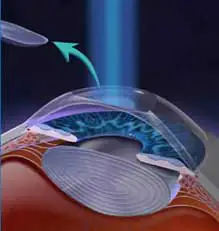 PRK is particularly effective in the treatment of astigmatism, myopia, hyperopia and presbyopia : in this case the specialist removes the most superficial central part of the cornea, called the corneal epithelium, thus obtaining a flattening. PRK is an outpatient procedure. Hospitalization is not required. The surgery takes a few minutes and you remain awake the entire time. In some cases, a mild sedative is given by mouth. Most people do not feel any pain during PRK. The eyes are first anesthetized with a few drops of anesthetic eye drops. The quality of the excimer laser instrument is fundamental for the good outcome of the operation. Some types of laser are more suitable for the treatment of myopia, while others have strengths in the treatment of hyperopia and astigmatism.
LASIK (Laser-assisted In situ Keratomileusis) is the most performed laser eye surgery in the field of refractive surgery in the USA. It is an operation performed with an excimer laser. Its popularity is given by the advantages that the patient benefits from, such as the almost absence of pain and good visual quality from the day after the operation . It is also used as a technique to correct any previous unsuccessful laser interventions.  During LASIK surgery, an instrument called a microkeratome is used to create a thin circular flap (or flap) on the surface of the cornea. The flap is folded over and placed laterally. FemtoLASIK is the evolution of LASIK. During the operation, a high-precision laser instrument called FemtoLASER is used – instead of a microkeratome – to cut a thin circular flap (or flap) on the surface of the cornea with great precision. As in the LASIK technique, the flap is folded down and placed laterally. Once the internal part of the cornea is exposed, the excimer laser beam comes into action which reshapes it, correcting the refractive error. Finally, the layer of corneal tissue – previously raised – is repositioned without the need for stitches, as the adhesion between the two parts of tissue is already high after just one minute. LASIK laser eye surgery is technically more complex but more comfortable for the patient who wants to operate on astigmatism, myopia, hyperopia and presbyopia. Given the greater complexity of the operation, the costs of laser surgery using LASIK are usually higher than PRK.
A more recent technique is SMILE. In this case, the Femtolaser is used to isolate a small piece of cornea from the deepest part which is removed thus changing the curvature of the cornea. The excimer laser is not used. It is a more invasive technique than the previous ones and the surgical cases performed to date are more limited compared to PRK and FemtoLASIK techniques. PRK, FemtoLASIK and SMILE are three types of effective and safe laser surgery. However, one technique may be more suitable than the other depending on the case . Only an expert surgeon and a cutting-edge refractive surgery center will be able to advise you on the most valid and appropriate method for each individual case.
Astigmatic Keratotomy is a surgical technique used to correct non-pathological regular astigmatism, such as keratoconus . It consists of making small curved incisions placed in the peripheral part of the cornea using the Femto-Laser. 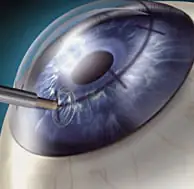 This technique allows you to obtain excellent results in simple astigmatism of medium to high degree while safeguarding the central part of the cornea. It is often used with excellent results when astigmatism is present in patients undergoing cataract surgery or artificial lens implantation or corneal transplant. Astigmatic keratotomy is performed under topical anesthesia (anesthetic eye drops) and convalescence lasts approximately 24 hours with minimal postoperative discomfort.
The ideal intervention for severe conditions of astigmatism, myopia, hyperopia and presbyopia is the implantation of phakic intraocular lenses (IOLs), also called intraocular contact lenses. They are particular lenses made of silicone or collamer useful for correcting vision defects such as myopia, hyperopia and astigmatism, even of a high degree (10-25 diopters).  They are similar to regular contact lenses, but are implanted between the cornea and the iris or just behind the iris. The novelty consists in being able to obtain the same results as LASIK without removing eye tissue. In some cases, phakic lens implantation and LASIK can be combined to achieve optimal correction. Implantable lenses are suitable for patients for whom another vision correction procedure cannot guarantee good results, such as in the case of a cornea that is too thin or high degrees of astigmatism, myopia, hyperopia and presbyopia. The type of lens implanted is essential in determining the quality of vision. There are different types, the most common are:
The High Tech lens is the new solution for “high definition” vision. During the phacoemulsification surgery, a High Tech lens is introduced in place of the natural crystalline lens which is removed. Two weeks after surgery, the quality of vision obtained with the photosensitive lens is evaluated, as well as any defects such as myopia, astigmatism or hyperopia. Once implanted in the eye, the visual result can be modified to the patient’s liking by simply illuminating this intraocular lens with a dedicated light beam. This surgery has the advantage of being able to correct high degrees of myopia, hyperopia, astigmatism, and even presbyopia.
Phacorefractive can be used to correct high defects of astigmatism, myopia, hyperopia and presbyopia in patients over the age of 45 . In this case, the natural crystalline lens, even if transparent, is replaced with an intraocular lens (artificial crystalline lens). This operation can also be performed on patients who have already received laser treatment, but with poor results. If you use the latest generation intraocular lenses, you can also correct presbyopia and hyperopia. The cost of this type of surgery varies depending on the type of intraocular lens used.
The cost of laser eye surgery varies depending on the type of technique used and the type of laser supplied to the refractive surgery center . An excellent refractive surgery center is usually equipped with the latest generation lasers and performs all the surgical techniques. The cost for laser surgery on both eyes varies from 2500 to 4500 euros . The PRK technique usually costs less than FemtoLASIK and SMILE. While phakic lens, high-tech or phacorefractive lens implant interventions cost around 4000 euros per eye. A study by the American Cornea Research Foundation has shown how the cost of this type of intervention is usually amortized in 4/6 years if we consider the cost incurred by each individual for glasses, contact lenses and any complications related to them such as infections or ocular inflammation. Furthermore, the level of satisfaction of those who undergo surgery is far higher than that of those who use contact lenses.
You might also be interested in the following testimonials from Dr Badala's patients:
You might also be interested in the following videos on similar topics: